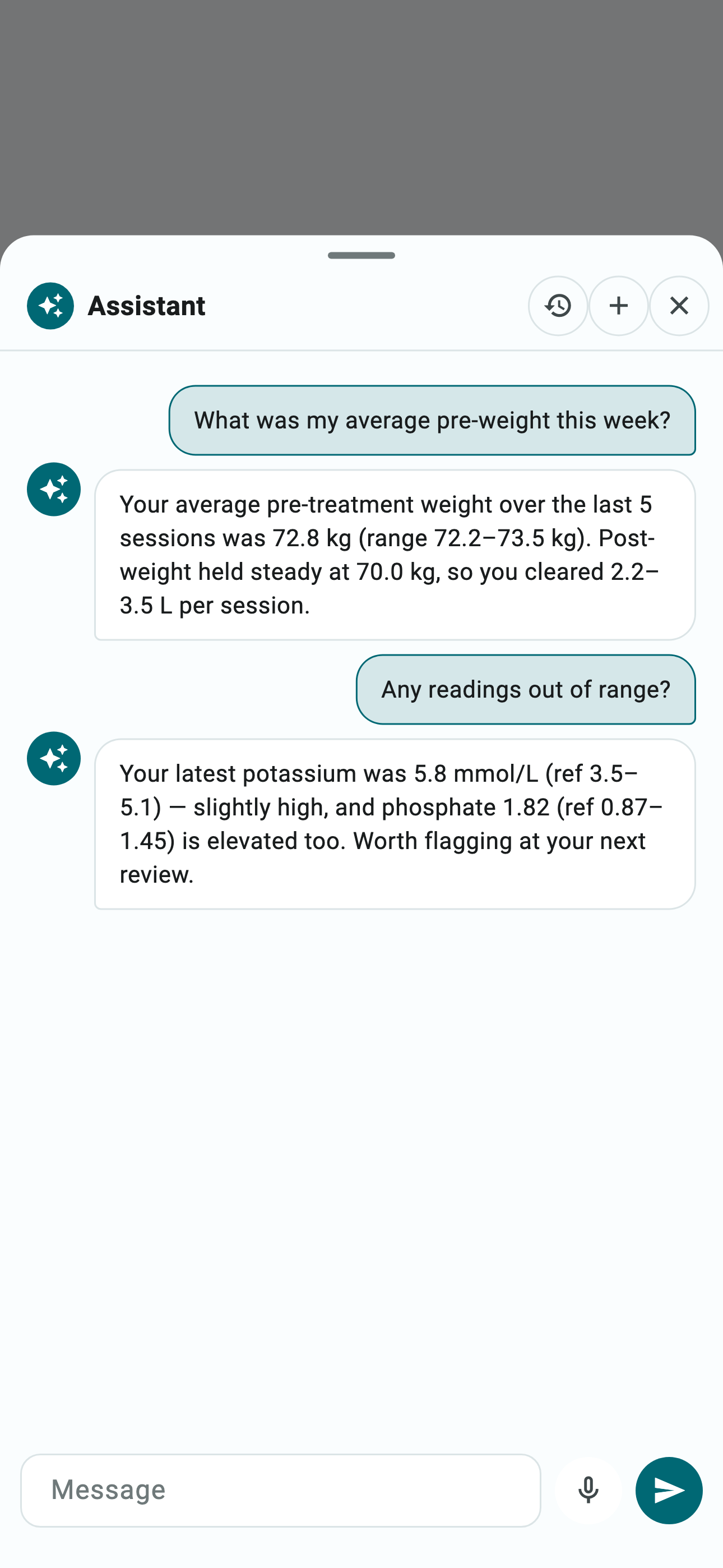
A generic chatbot can tell you what a blood marker means. It can't tell you why yours moved this month, because it has never seen your numbers. Living with a condition, that second question is the only one that matters — and it's the gap I wanted to close.
It reads my situation before every answer
The idea is simple, and the whole thing hangs on it: before each reply, the app builds a fresh prompt from my live data —
- my current or most recent session,
- a summary of my latest blood results and how they've moved,
- my supplies and what's running low,
- and the relevant notes from my knowledge base.
So the model isn't recalling facts about the world. It's reasoning over a snapshot of my situation, refreshed on every message. Ask the same question next week and the answer changes, because the numbers underneath have.
The itch, explained
That late-night question worked because retrieval is keyed to symptoms, not just keywords. Say "I've been itchy," and the assistant knows which markers tend to drive it, pulls those from my recent results, and points at the one that actually moved. The question is fuzzy; the answer is grounded in my own data. That combination is the part worth engineering.
Voice, because my hands are busy
During a treatment my hands aren't free, so I can just talk to it — audio goes straight to the model, which for this app beats on-device speech-to-text on accuracy and effort. I speak, it reads my data, it answers.
The pattern, generalised
Strip out the health specifics and this is a function-calling assistant whose context is rebuilt from live application state every turn, with retrieval keyed to intent. That pattern works for any product sitting on structured user data — support, finance, operations. The data changes; the architecture doesn't.
Building assistants that reason over a business's own live data — safely, grounded in real records — is exactly the kind of work I do at twentytwotensors. If that's a system you need, get in touch.
Next: giving this assistant hands, so it can act in the app instead of only talking.