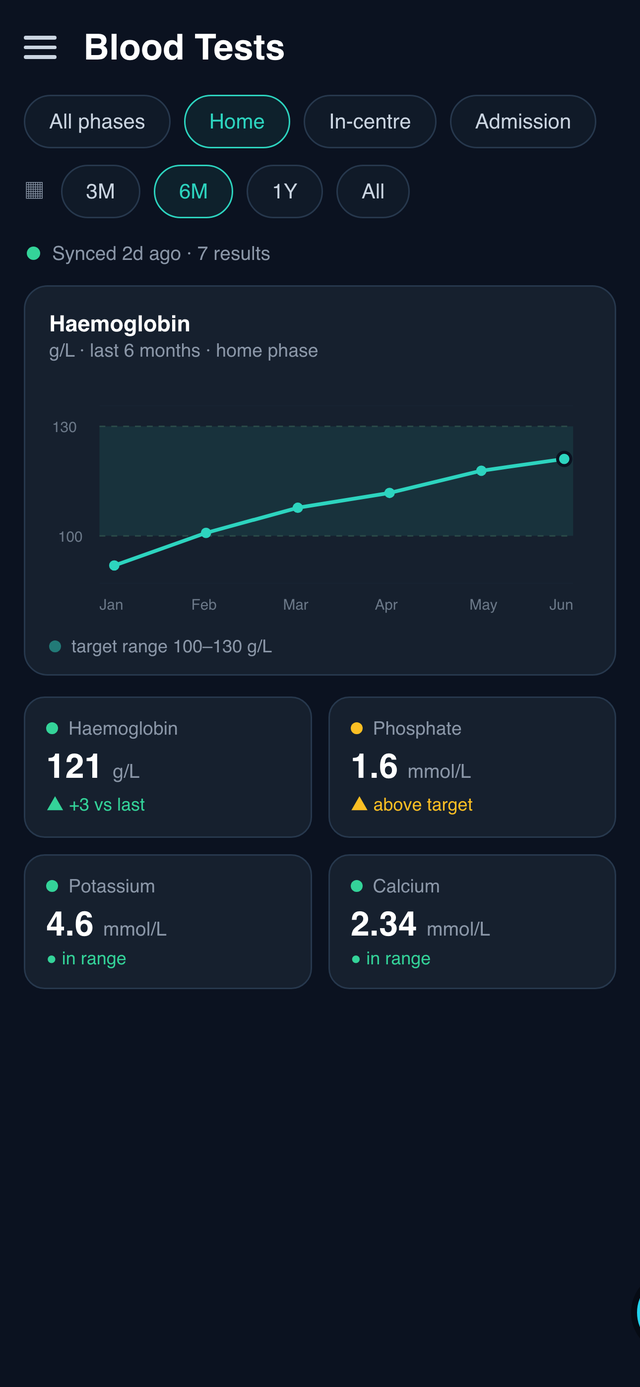
Two years of monthly panels is a lot of numbers over a lot of dates. Any single result barely means anything on its own — what I actually care about is the direction. A folder of PDFs holds all the data and answers none of that. So the real work wasn't drawing a chart; it was getting the data into a shape where the direction became obvious.
The boring schema that made it easy
I store results in long format — one row per marker, per datetime — not a wide table with a column per marker. It sounds like a detail, but it's the whole trick: adding a new marker never changes the schema, and every chart becomes a simple filter and sort. Boring, and exactly why it keeps working.
One bad month shouldn't erase the rest
Here's the thing that nearly ruined the charts. Every result is tagged with a phase — at home, in a unit, or during a hospital admission — because a rough spell in hospital throws out extreme values. Plot those on the same axis as steady months and the storm flattens everything else into a flat line, and you learn nothing. Tagging the phase lets me filter the storm out, or look at it alone, so the at-home trend stays honest. Those filters sit at the top of the screen above.
Where I deliberately didn't use AI
The results arrive clean and structured, so reading them is a regex job, not an AI job. I only reach for a model when the input is genuinely messy or the task genuinely needs judgement — and a well-formatted result line is neither. That restraint is a habit worth keeping: use the simplest thing that works, and save the model for the part that actually thinks.
Next: the other thing that quietly piles up when you treat at home — the supplies — and the night I nearly ran out of them.